
What Are the Benefits of Creatine and How to Take It
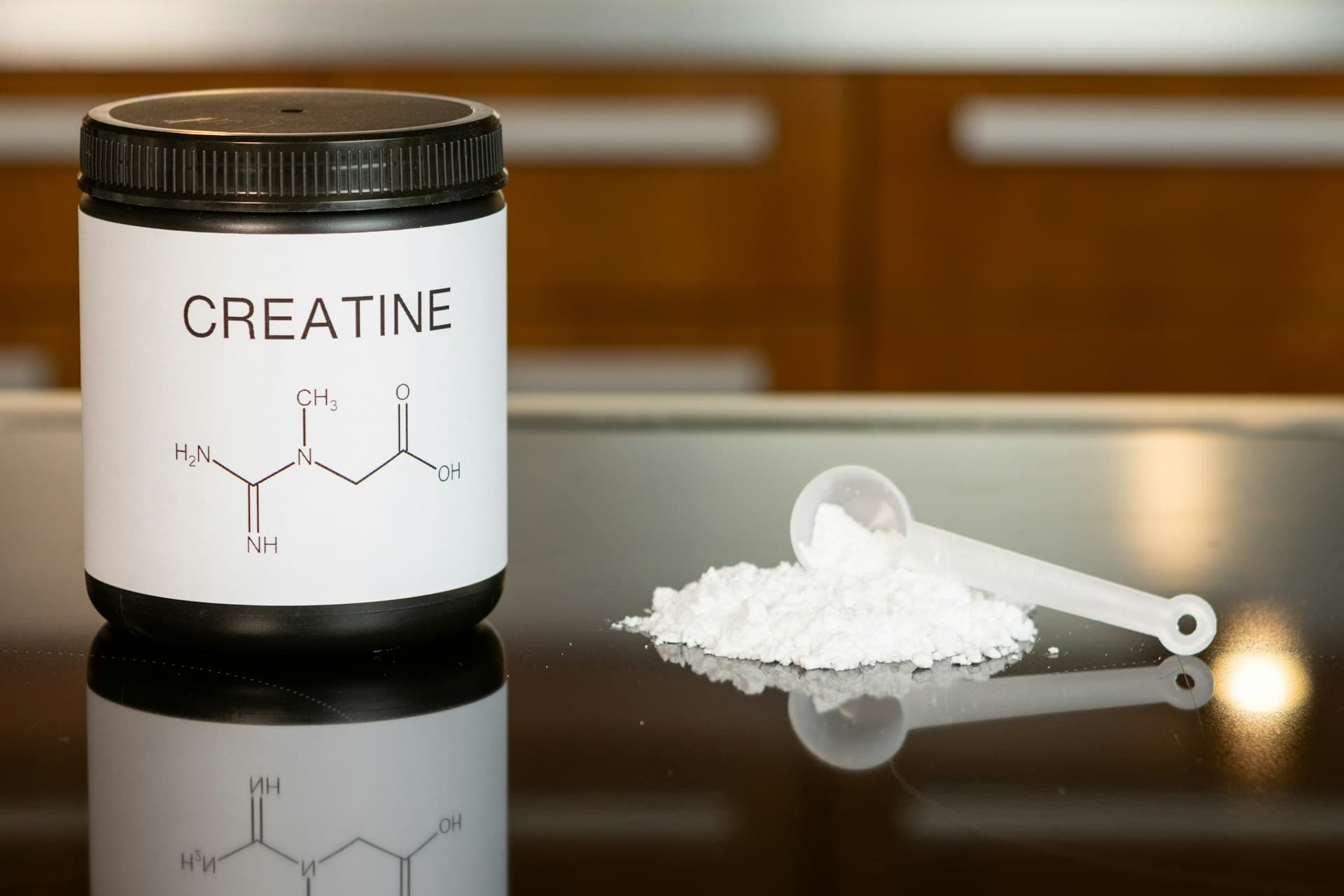
Creatine is the most studied sports supplement in the world. With over three decades of clinical research, it is the only supplement — alongside protein — to achieve the highest level of scientific evidence for improving athletic performance. Yet it remains surrounded by unfounded myths. This guide answers everything with hard data.
What Is Creatine and How Does It Work?
Creatine is a naturally occurring compound the body synthesizes from the amino acids arginine, glycine, and methionine, primarily in the liver and kidneys. About 95% of the body's creatine is stored in skeletal muscle as phosphocreatine (PCr). The body produces roughly 1–2 g per day on its own; the rest comes from food, particularly red meat and fish. Those following vegan or vegetarian diets have lower baseline stores and tend to respond better to supplementation. (Forbes et al., Nutrients, 2021 — PMC7910963)
During short, high-intensity exercise, ATP (the muscle's energy currency) depletes within seconds. Phosphocreatine steps in by donating its phosphate group to ADP to instantly regenerate ATP via the enzyme creatine kinase. Increasing muscle creatine stores through supplementation extends this energy system, delaying fatigue and enabling superior performance.
Benefit #1: Increased Strength and Muscular Power
This is the most documented benefit of all. A 2025 meta-analysis analyzed dozens of randomized controlled trials and confirmed that creatine significantly increases maximal strength and explosive power, with strength gains up to 20% greater than placebo in untrained individuals. In already-trained athletes, improvements are more modest but still significant. (Lanhers et al., 2025 — PMC12665265)
The mechanism is simple: more phosphocreatine available = more ATP regenerated during effort = more reps completed before muscular failure.
Benefit #2: Muscle Mass Growth
Creatine promotes hypertrophy through three distinct mechanisms:
- Indirect stimulus: it allows training at higher volumes and intensities, the primary driver of hypertrophy.
- Cell swelling: increases intracellular muscle water content, an anabolic signal that stimulates protein synthesis.
- Direct anabolic action: may elevate IGF-1 levels and reduce muscle protein breakdown.
The initial weight gain (1–2 kg in the first weeks) is due to intramuscular water retention — physiological, harmless, and not visible as bloating. (Kreider & Stout, Journal of the International Society of Sports Nutrition, 2021)
Benefit #3: Faster Post-Workout Recovery
Creatine accelerates muscle glycogen resynthesis after exercise and reduces muscle damage markers such as CK (serum creatine kinase) and LDH (lactate dehydrogenase). This translates to less muscle soreness in the days following training and the ability to train more frequently while maintaining quality. Harvard Health (2024) highlights that creatine, combined with adequate protein intake, significantly accelerates muscle tissue healing after intense exercise. (Harvard Health, 2024)
Benefit #4: Improved Cognitive Function
Less known but equally documented. The brain is the second organ in creatine concentration after muscle. A systematic review published on PMC demonstrated that supplementation improves short-term memory and reasoning abilities, especially under sleep deprivation, mental stress, and in vegan populations (where brain creatine stores are lower). The effect is most pronounced when baseline cerebral creatine reserves are reduced. (Avgerinos et al., 2018 — PMC6093191)
Benefit #5: Fighting Sarcopenia in Older Adults
With aging, creatine stores naturally decline, contributing to muscle mass loss (sarcopenia) and reduced functional strength. Creatine supplementation combined with resistance training has been shown to effectively counteract sarcopenia, improve grip strength and chair-rise capacity, and reduce fall risk. The systematic review by Forbes et al. (2021) concludes that creatine has therapeutic and health benefits across the entire lifespan. (PMC7910963)
Benefit #6: Clinical and Therapeutic Applications
Research has explored creatine in clinical settings with promising results. In patients with COPD (chronic obstructive pulmonary disease), supplementation increased lean mass, peripheral muscle strength, and quality of life. In patients with chronic heart failure, 20 g/day for 5 days improved skeletal muscle endurance. Preliminary studies also show potential in neurological conditions such as Parkinson's disease, ALS, and traumatic brain injuries. (Forbes et al., Nutrients, 2021 — PMC7910963)
How to Take It: Dosage
Two scientifically validated protocols exist:
- Loading Protocol: 20 g/day split into 4 × 5 g doses for 5–7 days, then 3–5 g/day maintenance. Saturates muscle stores in about 1 week. Recommended when fast results are needed.
- Gradual Protocol (no loading): 3–5 g/day continuously. Reaches saturation in 20–28 days. Better tolerated, no gastrointestinal side effects. The recommended protocol for most people.
Both protocols produce the same long-term results. The only difference is the speed at which muscle saturation is achieved. (Rawson & Venezia, 2021 — PubMed 34234088)
How to Take It: Timing
When you take creatine matters less than with other supplements, but research points to clear preferences:
- Post-workout: a double-blind RCT (2022) showed that creatine taken after training produces slightly superior body composition adaptations. The post-exercise anabolic environment enhances muscle uptake. (PMC9708881)
- With carbohydrates: insulin stimulated by carbs enhances creatine transport into muscle by up to 60%. Take it with fruit juice, a banana, or a full meal.
- On rest days: timing is irrelevant. Take it with any meal. Daily consistency matters far more than the exact moment.
Practical rule: post-workout with carbs on training days, with any meal on rest days.
Which Form to Choose?
Dozens of variants exist on the market (ethyl ester, HCl, Kre-Alkalyn, buffered, micronized, etc.) often marketed as superior. The scientific reality is clear: no form has demonstrated superiority over creatine monohydrate in controlled studies. Monohydrate is the only form with 30+ years of clinical evidence and is also the most affordable. Preferably choose products with Creapure® certification (manufactured in Germany to pharmaceutical standards) to guarantee purity and absence of contaminants. (Frontiers in Nutrition, 2025 — Frontiers)
Is It Safe? Myths Debunked
- "It damages the kidneys" — False. Over 25 years of clinical research have found no kidney damage in healthy individuals at recommended doses. Creatine raises serum creatinine, but this is a harmless physiological effect, not damage. Only those with pre-existing kidney disease should consult a doctor. (GSSI — 25+ years of data)
- "It's a steroid" — False. It's a natural compound produced by the body, legal in all sports and approved by all international anti-doping organizations.
- "It causes visible bloating" — False. It increases intracellular muscle water, not subcutaneous. No visible swelling or puffy appearance.
- "You need to cycle it" — False. No scientific evidence supports cycling. Continuous use at 3–5 g/day is safe and does not reduce effectiveness over time.
- "It's only for gym-goers" — False. Documented benefits also for older adults, vegans, team sport athletes, and people with neurodegenerative conditions.
Who Responds Best?
Not everyone responds the same way: about 25–30% of the population are "non-responders" — they already have muscle creatine stores near saturation and benefit less from supplementation. The categories that respond best are: vegans and vegetarians (lower baseline stores), untrained individuals, older adults, explosive sport athletes, and people with low protein intake. If after 4–6 weeks of supplementation you notice no change, you may belong to this category.
Scientific References
- Forbes SC, et al. (2021). Creatine in Health and Disease. Nutrients. PMC7910963
- Lanhers C, et al. (2025). Effects of creatine supplementation on muscle strength gains. PMC12665265
- Avgerinos KI, et al. (2018). Effects of creatine supplementation on cognitive function. PMC6093191
- Rawson ES, Venezia AC. (2021). Creatine Supplementation: An Update. PubMed 34234088
- Candow DG, et al. (2022). Effects of creatine monohydrate timing on resistance training. PMC9708881
- Harvard Health Publishing. (2024). What is creatine? Potential benefits and risks. Harvard Health
- Frontiers in Nutrition. (2025). Common safety concerns of creatine monohydrate. Frontiers
- GSSI — Gatorade Sports Science Institute. The Safety and Efficacy of Creatine Monohydrate. GSSI





Team WorkoutX365
Fitness Experts